Sunday, December 14, 2025

 I find myself in what would seem to be very desirable circumstances regarding information.  The internet gives me access to books, blogs, videos, social media, news feeds, email, texts, and even good old phone calls.  Since I am a retired empty nest man with just a few life maintenance activities to tend to, I have ample time to explore the available information.  Yet I find myself frustrated by my lack of discipline in how I make use of the resources available.  

One default mode I seem to share with many folks is a tendency to use my phone to mindlessly scroll through various articles.  The social media, search engine, and artificial intelligence software is very good at feeding me more and more bite sized chunks of things that I seem to have shown interest in.  Consequently, the scrolling can become somewhat akin to a substance abuse disorder.  

I used Facebook for a couple of decades and found that I was reading many fewer things that could be seen as edifying.  When I posted my thoughts on various subjects, I became increasingly frantic to see whether I got likes or comments on what I had written.  I found myself checking many times a day to see where those stood, even though I knew full well that the data would trickle in over a day or three and would prove to be of very little importance or even interest.

I got off Facebook about a month ago.  I don't really miss it except for one small thing.  Facebook was one of the few places where I strove to put my thoughts into writing.  Passive consumption of other people's creative content can certainly be worthwhile, but I miss the discipline of organizing and recording my own material.  

So here I am on Blogger once again.  I see that most of my writing are more than a decade old.

The Left Right 2D Trap

 Humans are incredibly multidimensional.   Nonetheless, it seems that many, maybe even most, debates in


 recent years are couched in terms of a single dimension.  


One such spectrum that seems greatly overused is the left/right political one.  Leftists are said to 


believe "such and such" which is thought to be quite contrary to what right wingers are adamant about.  


For example, leftists might be said to support big government whereas right wingers want small government. 


 My personal bias shows even in how I have selected terminology for this example. 

 I suspect my "leftist" friends would start by denying that they are leftist. 

They would likely prefer to be described as compassionate.  

They might be happy to see the size of the government diminished in certain areas such as military defense 

spending or immigration enforcement.  They might see my calls for smaller government as a disguised 

cruel streak where I may be indifferent to the suffering of the poor, the sick, or the weak.  

Each of us is puzzled by what seems to be a gross misunderstanding of our respective positions.  

Perhaps my so-called leftist friend believes they are well aware of the limitations of governmental

 solutions to such things as poverty. They may espouse a thorough understanding of the fact

 that government spending is necessarily limited to one degree or another.  I on the other hand am eager to

 see many government programs that are meant to help the poor as actually contributing to their plight 

because of a misunderstanding of human nature and a faulty approach to stimulating productivity as a 

means to increase the resources available in a way that reduces the likelihood that a large portion of the 

citizenry will find themselves suffering from a lack of life's necessities.  

We may also differ in our attitude toward whether it is inherently unfair for some to have so much


 more than others, even when the poorest have access to basic food, clothing, and housing.  


Some may believe that the very existence of rich and poor is a sign of failed sociopolitical policies.


I find it interesting that the very idea of left and right in politics can be traced back to the seating


 chart for the French National Assembly during the French Revolution. Those seated on the right 


of the assembly president's right generally wanted to preserve traditions of the king and church.  


Those seated on the left opposed monarchy and sought many changes to the existing order.  


Of course, in the United States there has never been a monarchy or a state church. 


 The French left wing agenda of republicanism is foundational in the US constitution. 


 Applying left and right as descriptors for the US congress is immediately problematic. 


Nonetheless, language morphs over time.  Here we are in the 21st century United States and we tend to 


use left and right freely with the supposition that we have mutual understandings of what we mean.


I hope to avoid a simple linear spectrum unless I am addressing very specific topics.  


Saturday, November 29, 2025

Coercion and Influence

Christopher Walken, as a character in the movie "Seven Psychopaths" is confronted by a man with a shotgun who commands him to put his hands up.   Walken says, "No".  The other character is astonished and says, "Why not?"  Walken says, "I don't want to".  The gunman says, "I've got a gun. "   Walken says, "So what?" The other guy says,"That doesn't make any sense".  Walken replies, "Too bad."

I love this scene.  One might say that Walken was being coerced into cooperating with the gunman.  However, by simply refusing to comply, Walken defies coercion.  When the gunman argues with him about it, Walken defies influence.  Of course Walken might pay for his intransigence with his life.  Nonetheless, he has rendered both coercion and influence useless for changing his behavior.

Once obese human beings achieve weights of approximately 1000 pounds, they are generally unable to walk or even fit through the door of their room.  Yet they require many thousands of calories of food each day to maintain their incredible girth.  Clearly someone is complicit by purchasing, preparing, and presenting food to the bed bound person.   Yet, this sort of extreme obesity is definitely life threatening.  Bathing and using the toilet require a great deal of help from others.  All sorts of complications and discomforts accrue to the obese person. 

Why would the patient's helpers continue to help the patient maintain this wretched existence?  For reasons that vary, they are unwilling to tell the patient no when they demand or even just request the massive amounts of food and special care.  The helpers are often family members who love the patient and long for them to be restored to health.   Yet they do not make simple changes that will enable the patient to lose weight.

Coercion and even influence are real, but the means to render them ineffective are available to any human with a "free will".  We all possess the incredible power to refuse to cooperate. 

Of course, a strong adversary can force us to our knees.  But then, we have not really yield to their demands.  Our body has been forced into a position we disagree with, but our minds remain uncompliant.

Even brutal beating and even torture may hurt us so much that we speak agreement or some sort of information.  However, the pain is used to force the brain, mouth, and lips to move somewhat like the physical force might be used to force us to our knees.  Our will and some portion of our mind are not yet conquered.

It is humbling to consider that we often say that we were forced to do something or convinced to do something that is against our will, and yet realize that the option to say, or at least think, no was always an option we had available.

Matthew 5:37 New International Version (NIV)

37 All you need to say is simply ‘Yes’ or ‘No’; anything beyond this comes from the evil one.
When we comply despite or desire to resist, we are making some sort of bargain with ourselves.  We hope that in the overall scheme of things, we will benefit more by agreeing than we would by resisting.  For example, we hand our wallet to an armed robber in hopes that compliance will result in less disruption to our life than would resistance.  In a sense, we are making a bargain with ourselves.  We believe that we have escaped more onerous costs by simply handing the wallet to the thief.

We actually have no ability to forecast the future well enough to ensure that the bargain we have made will provide the desired outcome.  In the case of a robbery, the thief may decided to kill us despite our compliance. Alternatively the loss of the wallet may start a chain of events that leads to consequences far more dire than we could have imagined.  For example, losing our identification documents might result in our being falsely imprisoned, leaving our family to suffer greatly before the matter can be resolved.  Or the emboldened robber may decide that our compliance denotes that we are an easy mark that should be subjected to more and more onerous demands or other misdeeds.

Often we say yes, when we want to say no, simply because we want to avoid the unpleasantness of experience dismay or anger on the part of the person who has made the request.  If we seek to avoid all manner of unpleasantness and avoid all sorts of confrontation, no matter how mild, our lives become unbearable.

We will benefit from realizing that saying no is always an option.  We will benefit even more if we choose wisely as to when to exercise the option to say no.

Only God can see the bigger picture and comprehend the future consequences of our decsions.  Let us be quick to turn to him for guidance.  If we are not aware of direct guidance when we ask for it, let us fall back on what we know to be true from our experience, our limited wisdom, and our understanding of God's will as revealed to us in Bible study, Godly teaching, and Godly examples.  We can rest in the knowledege that God will honor our desire to be like Him.  If we fail, he can help us to recover and to do better in the future.  As we trust in him as our savior, we are assured of the ultimate resolution of this life's difficulties: eternity with God.  A renewed body and spirit.  No more crying, pain, illlness or death.


Tuesday, January 15, 2019

Free Will versus Determinism

Free will versus determinism has always fascinated me.   A deterministic universe is easy enough to propose, but an odd thing to defend.  After all, any defense of the idea supposes that the defender is doing nothing more than speaking predetermined words by making predetermined vocalizations with predetermined muscular contractions and the expulsion of a predetermined amount of breath.  All thought behind the argument is composed of predetermined firing of neurons.  The proponent had no choice but to offer the defense.

In his book, Beyond Freedom and Dignity, B.F. Skinner argues that free will and morality do not exist.  He sees all human behavior as the product of inherited biology plus environmental influences.  Oddly enough, he is optimistic about the resultant opportunity for a technocratic elite to engineer human society for optimal functioning.  Skinner seems blind to the fact that the technocratic elite would also be operating strictly according to their biological nature and environmental nurture (a nurture bereft of moral underpinnings).

As I read his book, years ago, I was constantly struck by the thought that following his logic, he was thoroughly compelled to write out his argument, and I would be thoroughly compelled to agree or disagree with him.  By his view, it would seem that the book was a completely pointless exercise.  Any attempt to adopt his ideas would just be part of the ongoing deterministic dance of whatever it is that we call matter and energy.

I knew that Skinner was married and had a daughter.  What a grim, dark world were he to truly believe that all the affections between them were simply part of that same deterministic dance.  Any choice to live out love for one another would be an illusion.  In addition,  his idea that morals were also illusory put to rest any idea that loving one another would be good versus evil.

Beyond Freedom and Dignity was no obscure academic tome.  When published in 1971, it made the New York Times best seller list for 18 weeks!  Skinner was a renowned behavioral psychologist and social philosopher.  I truly hope that he did not believe what he espoused.  A thorough acceptance of his ideas amounts to an early entrance program for hell.  Love is a choice, and it is good.  Without free will or morality, love cannot exist.

Skinner was likely a very intelligent fellow.  Nonetheless, he was a fool.


Friday, January 04, 2019

Apocalypse Guarranteed

The Apocalypse.  For many of us the phrase holds lasting fascination.  What calamity will befall the human race and the natural world.  Who will survive?  What will their lives be like once the current complex of industry, technology, and government are swept away?

Post apocalyptic literature necessarily presumes that at least a few people survive the great catastrophe.  Without the survivors there are no characters for the story apart from perhaps microbes or mutated rats, which would grievously constrain the story line.

Oddly enough, all our history and personal experience point to an apocalypse that no one will survive.  Life is hard, and then each of us dies.  Our lives may entail seasons of contentment, moments of joy, and glimpses of bliss.  There will most certainly be pain, loss, and for those who live long enough, an inexorable deterioration of body and likely degradation of our minds.  Even the most optimistic of us is aware of that some mix of pain and pleasure inevitably ends in death, although a few may dream of a breakthrough that allows humans to live centuries or even millenia.   Very few imagine that this life could continue on for all eternity.  Fewer still would find that prospect appealing.

In an interview, famed atheist Richard Dawkins was asked if he would like to live forever.  He was quick to say no.  Perhaps ten thousand years would be desirable, but no more than that.   I wondered how he arrived at 10,000.  One hundred years would bring so many joys and trials that they are beyond my imagining, and at 68 years of age, they are already beyond my ability to recount.  A thousand years would surely consist of a multitude of experiences that would be well beyond remembering and ordering rightly.  Ten thousand strikes me as a cop out number.  It is large enough to sate the imagination of the most ardent optimist.

As things stand, this life ends in a century plus or minus a few decades.  It ends for every human being.  The apocalypse may continue piecemeal until that one stray meteor demolishes the earth.  Or perhaps there will even be time for the sun to grow into a
red giant, consuming the earth and its neighbors.

The most determined authors of a distant future suppose technology that allows humans to populate planets near distant stars or even man made arks, self sustaining and wandering the universe. If we allow for such leaps of technological capability, we still face the constant expansion of the universe, ultimately leaving heavenly bodies so far separated that they are incapable of even observing each other.  And current cosmological prognostications suppose a gradual grinding to a halt referred to as the heat death of the universe.

Let us think more deeply about such scenarios that allow the human race to survive for many eons more, and yet is accomplished only through the living and dying of enormous numbers of generations.  What satisfaction is to be found in that.  Like most people, I know little about the generations that preceded me and I can only speculate on those to succeed me.  I have seen a single photograph of one great grandfather.  I have a very sketchy oral history of the barest outlines of his life.  I met another great grandfather, who seemed to a very young me as being so old, doddering, and demented that I was unable to connect with him in any depth. That leaves two other great grandfathers of whom I know nothing.  Presumably I have eight great-great grandfathers, but their history is a complete mystery to me.

We may be sure that we will most certainly not "live on in the hearts and minds of generations to come".  At best a caricature of us will survive two or three generations.  And then we will be at most a single name in a laboriously crafted genealogy.  Perhaps some dubious legend will be attached to the name.  Nothing more.

Death is the apocalypse that devours all humans.

Unless.  Unless there is a life greater than this one inhabited by a being greater than us all.  He is the Creator of space and time. He loves us so much that He has enabled us to choose to live for all eternity with Him.  Indeed, He will transform our body and
mind to enable us to experience that eternity without the constraints that currently plague us and make very long lives a dubious bargain.

Some find the prospects of creator, eternity, and resurrection to be, at best, myths generated to protect us for the very real horror of the apocalypse.  Others are not so charitable, and see such beliefs as a plague upon the human race, inhibiting us from being as great as we could be. I feel immense sadness for them. For them reality is a horror dotted with moments of happiness.  Their greatest hopes for the future lie in a multitudinous and yet finite number of successor generations who will know nothing of today's 7 billion souls as individuals, or perhaps even nothing of them as a cohort in the distant past.


Wednesday, October 31, 2018

Learning to Live in an Imperfect World

Our world is plagued by problems.  Each of the 7 billion plus humans on this planet is plagued by problems.  I have seen very few instances where a person argues that things are fine the way they are.  I see lots of instances where folks cry out for change.  It's those folks who might be willing to read this.

We want change.  We want problems fixed.  We want suffering eased.  Those of us who believe in God can call out to him and ask him to help us.  And he does.  But for reasons that are too great for me to understand, God has not immediately solved all problems and relieved all suffering.  He could, but he hasn't.

God has a plan that is bigger than I can understand.  I refuse to believe in a God that is no bigger than my understanding.  I insist on believing in a God that is good, because I see the beauty and love in this world.  The problems and pain arise from choices made by ourselves and perhaps by fallen angels.

I am willing to seek solutions.  I am also intent on beginning with working on myself.  I may influence others, but what good is that if I have not sought to improve myself.  God has answered my prayers for improving me.  He isn't done yet.  Just as with the world's problems, I don't know why he is taking his time.  But it is his time. It is his world.  And I submit to his will.

Friday, September 04, 2015

Visibility, Innocence, and Compassion

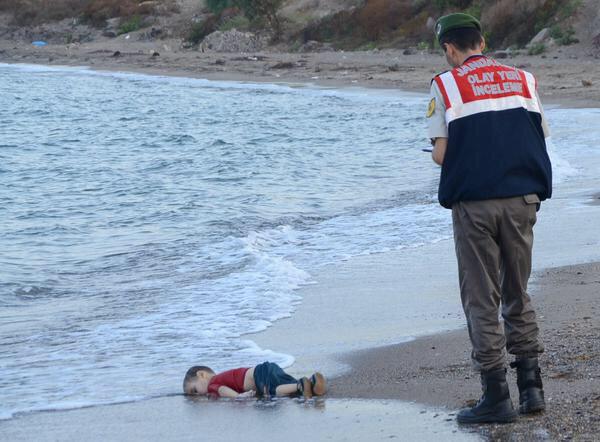
A recent news photo showed a policeman approaching a drowned refugee toddler.  An interview with the toddler’s father revealed that he had lost his wife and both of their children in a desperate attempt to cross the Mediterranean to a Greek island.   The image and the story work powerfully to make us aware of the plight of the many refugees worldwide who are desperately trying to move to a better life.

About 55 million people die worldwide, each year.  We cannot grieve for all in the same way.  We know little or nothing of most of them; we seldom know that they have passed away.  The image and story above  demonstrate how just a bit of visibility can increase our compassion for thousands of people.   Because it is a toddler who died, we know that he is innocent of any wrongdoing that could have contributed to his demise.  When we hear of war deaths, we may feel compassion for all involved, but particularly for non-combatants impacted by the violence.

Mass shootings are disturbing, but mass shootings of school students are particularly upsetting.  And the death of so many Sandy Hook elementary students was especially shocking.  The younger the victim, the greater the gut impact.

When we learn of a tragic death, the impact is greatest when the victim is young and innocent.  How then is it that we have hardened our hearts to deaths of children killed in their mother’s womb?  Surely one factor is that we do not see them, and seldom hear specific stories of their final days. An unborn child is close to invisible, so far as the public is concerned.  Photos of the bodies of aborted children are decried as too gruesome for publication.  Although abortion is legal, it is seldom spoken of publicly by those who chose to have one or perform one.

Euphemisms are also used to minimize the impact of an unborn child’s death.  Fetus is used when the child is unwanted.  Baby is invariably used when expectant parents look forward to a birth.  Attention is directed to the mother’s health, despite the fact that a small minority of abortions are done to prevent injury to the mother.  Implicit is the idea that an unborn child’s death is a minor tragedy compared to constraining a mother from making the decision to have the child killed.  A common assertion is that since it is the woman’s body, it is the woman’s decision.  That presumes that the baby is still a part of a woman’s body up until it is born.  Even if that were the case, there exist perfectly healthy people with a profound belief that they need to have one of their limbs amputated because the limb “doesn’t belong to them”.   It is a rare surgeon that agrees to remove a healthy limb.  How then is it that surgeons are readily found to end the life of a healthy baby, even if we were to accept the idea that the baby is part of the woman’s body?  

Sometimes visibility in the simplest sense of the word is not possible.  We must exercise the ability to envision the unseen that is one of the great gifts we have as human beings.  I urge each of us to use that ability to envision the plight of the innocent and persecuted so that we may feel the compassion needed to spur us toward creating a more just society.drowned toddler 2.jpg

Saturday, July 04, 2015

The Wisdom to Know the Difference

In 1941, Alcoholics Anonymous adopted a short prayer, a modified version of a longer one by Reinhold Niebuhr.  The AA version goes as follows:

God, grant me the serenity to accept the things I cannot change,
The courage to change the things I can,
And the wisdom to know the difference.

Simple, but not easy.

It seems our culture has adopted the mantras to the effect that  we can do whatever we dream of, whatever we work hard enough for, or whatever we pray fervently for.  We are exhorted to give ourselves fully to our passions, our dreams, our desires.   Age is not seen as a barrier, for “you are only as old as you think you are”  or “you are only as old as you feel” with the implicit admonition to think and feel young.  

Vast is the distance between those cliches and the reality that we experience most days.  They are meant as encouragement, and perhaps they work that way for a while, but soon enough we learn that there are things that we cannot change.  Many things.   Oh, we can nibble away at the edges of some problems, and it is good to do so. We may eventually eliminate this or that burden, or at least lighten it significantly.  Therefore, we can quite rightly ask God for the courage to change the things we can.  But serenity will certainly elude us if we cling to the idea that we can change everything if we just believe more or try harder.

Enjoy your victories.  Thank God for such courage and strength you have. Use them well. However, also gracefully accept the hard truth that there are things you will not change much, if at all.  Seek the wisdom to discern how you should expend your finite energy, intelligence, skills, and persistence. You are finite, and you mock God if you pretend otherwise.

Of course you should enlist the help of our infinite, all powerful God.  But it is foolish, even blasphemous, to suppose that he will do whatever you ask, just the way you ask for it, regardless of your motives.  God is not a genie to be summoned by rubbing the bottle of heaven with your prayers.  You are finite, and you mock God if you pretend otherwise.

If you are enjoying an abundance of energy, optimism, and blessing,  I am glad for you.  This essay may not seem much use.   I encourage you to store away the basic precepts for reference should that blissful state diminish.

On the other hand, if you feel overwhelmed and unable to change anything at all, I ask only that you move one tiny step to effect change that may seem insignificant for now.  During the depths of a clinical depression, I felt unable to exercise, despite the benefits it promised.  I read an article that exhorted me to stand up, walk 5 minutes in one direction and then walk back.  I did that.  I did it again, and again as days passed.  I soon found that I could go a bit further each day.  Eventually I was walking for an hour each day during my lunch.
But perhaps you cannot take an actual  step.  I am reminded of public figures like Stephen Hawking that are trapped in a body that cannot move. Let the step be metaphorical.  Choose to think of one thing that will change things for the better.  Ask God for the courage to change something, even if it is a single thought.  Ask Him to show you the truth about what you can do.

I write things like this primarily as reminders to myself.  I post them so that perhaps a single other struggling soul will be helped by them.

Thursday, July 02, 2015

That Saved a Wretch Like Me

Last week, President Obama sang the first verse of Amazing Grace at a memorial service for those slain in the mass shooting at an African Methodist Episcopal church in Charleston, South Carolina. Perhaps many of you will be aware that the song was written by John Newton, a slave trader who became a Christian. You may not know that Newton continued in the slave trade for a number of years following his confession of Christ as his savior. Newton wrote that first verse of Amazing Grace in 1848 while he waited for his ship to be repaired after a storm that so humbled him that he called out to God for mercy. Incredibly, that ship was rescuing Newton who had himself become a slave to a slave trader's African wife. Nonetheless, Newton went on to captain other slaving ships until ill health forced him to retire from the sea. Newton became a priest in the Episcopal Church in 1764. His reputation for wisdom and spiritual depth grew until he was embraced as a guide by many prominent people of his day, as well as by the church at large. Eventually, his eyes opened to the horror of the slave trade. He became active in the abolitionist movement.
The verse that President Obama sang was written by a man who had slain and tortured many African slaves while quelling revolts on his ships. Early in his career he was a notorious drunk and an enthusiastic participant in the common practice of raping the slave women. Even as he wrote "that saved a wretch like me" he was still early in the process of being redeemed and made Christlike. That process was ongoing when he died in 1807.
A Christian is not one who has turned to God and stopped sinning. A Christian is one who has turned to God because he is a sinner and needs a life time of grace from God to transform him into a likeness of Christ. Christians are aware that the transformation is not completed in this life. We are assured by God that He is glorified even in our weakness. We have been lost, found, and are still being guided home.

Saturday, June 20, 2015

One Nation Under God

One Nation Under God


The U.S. pledge of allegiance was written in 1893 as follows:


"I pledge allegiance to my Flag and the Republic for which it stands, one nation, indivisible, with liberty and justice for all."  Notice that there is not a reference to a specific country nor a reference to God.  The author Francis Bellamy, a Christian minister who was also a fervent Socialist,  actually hoped that the pledge could be used in any country.  However, he was actually enlisted to create the pledge and an accompanying flag raising ceremony by a magazine, The Youth’s Companion,  as part of a campaign to sell a U.S. flags to American schools and to increase subscriptions to the magazine.


The pledge was modified, against Bellamy’s wishes,  in 1923 to be more specific about which flag was being referred to:


"I pledge allegiance to the Flag of the United States of America and to the Republic for which it stands, one nation, indivisible, with liberty and justice for all."


Bellamy ran a successful campaign to popularize the pledge.  He appealed to school superintendents, governors, congressmen, and the president.  After being used widely for decades, the pledge was formally adopted by the U.S. congress in 1942.


It was modified one more time in February, 1954 with the addition of “under God” as follows:


"I pledge allegiance to the flag of the United States of America, and to the republic for which it stands, one nation under God, indivisible, with liberty and justice for all."


The change was made following six years of campaigning by various individuals and organizations, especially the Daughters of the American Revolution, the Sons of the American Revolution, and The Knights of Columbus.  President Eisenhower, baptized only a year earlier, was moved by a sermon that spoke of the need to make clear the spiritual foundation of the republic. His pastor, George Docherty, said "there was something missing in the pledge, and that which was missing was the characteristic and definitive factor in the American way of life." With Eisenhower’s fervent support, the pledge was adopted after previous failed attempts in Congress.


The Declaration of Independence, was written in 1776 and formally adopted by the Continental Congress, the forerunner to our current U.S. Congress.  The first two paragraphs made the spiritual foundation of the new nation very clear.


When in the Course of human events, it becomes necessary for one people to dissolve the political bands which have connected them with another, and to assume among the powers of the earth, the separate and equal station to which the Laws of Nature and of Nature's God entitle them, a decent respect to the opinions of mankind requires that they should declare the causes which impel them to the separation.


We hold these truths to be self-evident, that all men are created equal, that they are endowed by their Creator with certain unalienable Rights, that among these are Life, Liberty and the pursuit of Happiness.


Armed conflict towards independence had been underway for over a year by the time this declaration was adopted.  The references to a single God, creator of mankind, and the giver of basic human rights were foundational in explaining the need for such extreme measures.  If secularists were to revamp the Declaration of Independence, I find it hard to imagine what foundation they could use in God’s stead.  The idea that adding God to the pledge of allegiance was counter to the spirit and intent of our nation’s founders is absurd given their very clear references to God in the document that proclaimed the United States as a nation.


Recently, I was strongly struck by how thoroughly we have removed references to the one true God, our creator, from our everyday discourse, both private and public.   How is it that the very foundation of our successful country, with unprecedented freedoms and opportunities, could come to be seen as an aberration, or even an embarrassment, in daily conversations and in our social and public media?

I believe in God.  I trust in God.  I talk to God.  I do my best to hear God when he speaks, and to obey as he directs.   I am not ashamed.   Are you?